
Post-Quantum Cryptography in Web Browsers: The Next Generation of Secure HTTPS
Web browsers are at the forefront of the transition to Post-Quantum Cryptography (PQC). As quantum computing technology advances, the cryptographic algorithms used to secure websites, online transactions, cloud services and enterprise applications face a significant long-term security challenge.
Traditional public-key cryptographic algorithms, including RSA and Elliptic Curve Cryptography (ECC), are vulnerable in principle to attacks from sufficiently powerful quantum computers.
Although such attacks are not currently practical at the scale required to compromise modern internet cryptography, organisations must prepare for the possibility that they will become feasible in the future.
One of the most immediate concerns is Harvest Now, Decrypt Later (HNDL).
In this scenario, malicious actors record encrypted communications today, retaining them until quantum computing capabilities become sufficient to compromise the classical cryptography used to establish their encryption keys.
This makes PQC particularly important for organisations handling information that must remain confidential for many years, including government communications, intellectual property, financial information and sensitive customer records.
Post-quantum cryptography addresses this risk by introducing cryptographic algorithms designed to remain secure against known quantum-computing attacks.
Major browsers, including Google Chrome, Microsoft Edge, Mozilla Firefox and Apple Safari, already support hybrid post-quantum key exchange. Figure 1 shows why this matters for recorded HTTPS traffic.
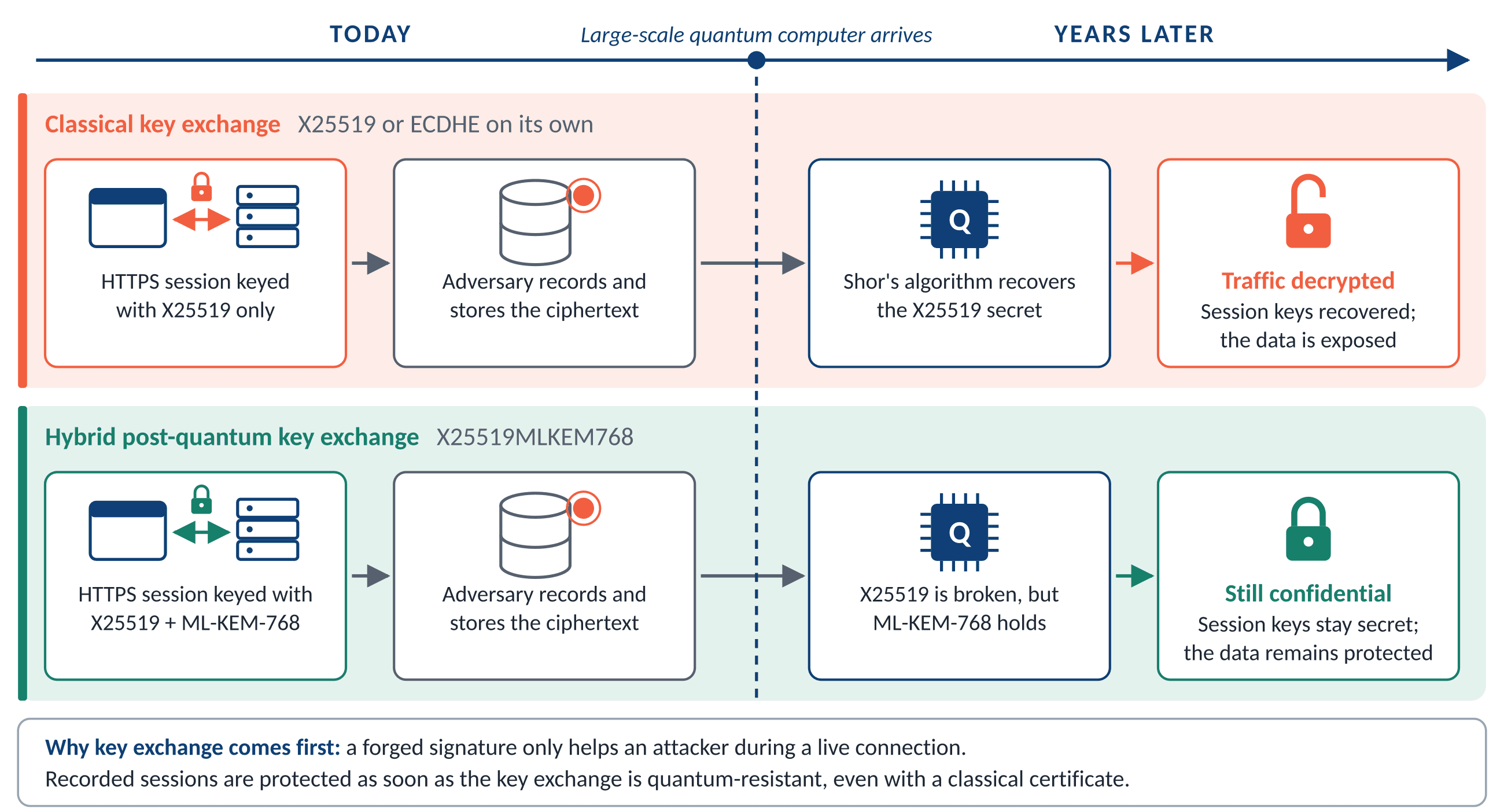
Figure 1. Harvest Now, Decrypt Later. Traffic recorded today can be decrypted once a large-scale quantum computer exists, unless the session keys were established with hybrid post-quantum key exchange.
A second major milestone has now been reached: Google Chrome supports post-quantum ML-DSA certificates within private Public Key Infrastructure (PKI) environments.
This creates new opportunities for organisations to move beyond protecting encrypted traffic and begin deploying post-quantum authentication through their existing certificate-management infrastructure.
Understanding Post-Quantum HTTPS
HTTPS relies on several cryptographic mechanisms, each performing a different security function.
These mechanisms must be considered separately when assessing whether an HTTPS connection is protected against quantum threats. Figure 2 shows a common example: a TLS 1.3 handshake whose key exchange is post-quantum while its authentication is still classical.
Security Function | Classical Cryptography | Post-Quantum Approach |
|---|---|---|
Key exchange | X25519, ECDHE P-256, ECDHE P-384 | ML-KEM, typically combined with classical X25519 |
Digital signatures and authentication | RSA, ECDSA, Ed25519 | ML-DSA |
Certificate issuance | RSA- or ECDSA-signed X.509 certificates | ML-DSA-signed X.509 certificates, with other PQ certificate formats emerging |
Symmetric encryption | AES-GCM, ChaCha20-Poly1305 | Existing algorithms remain suitable with appropriate security parameters |
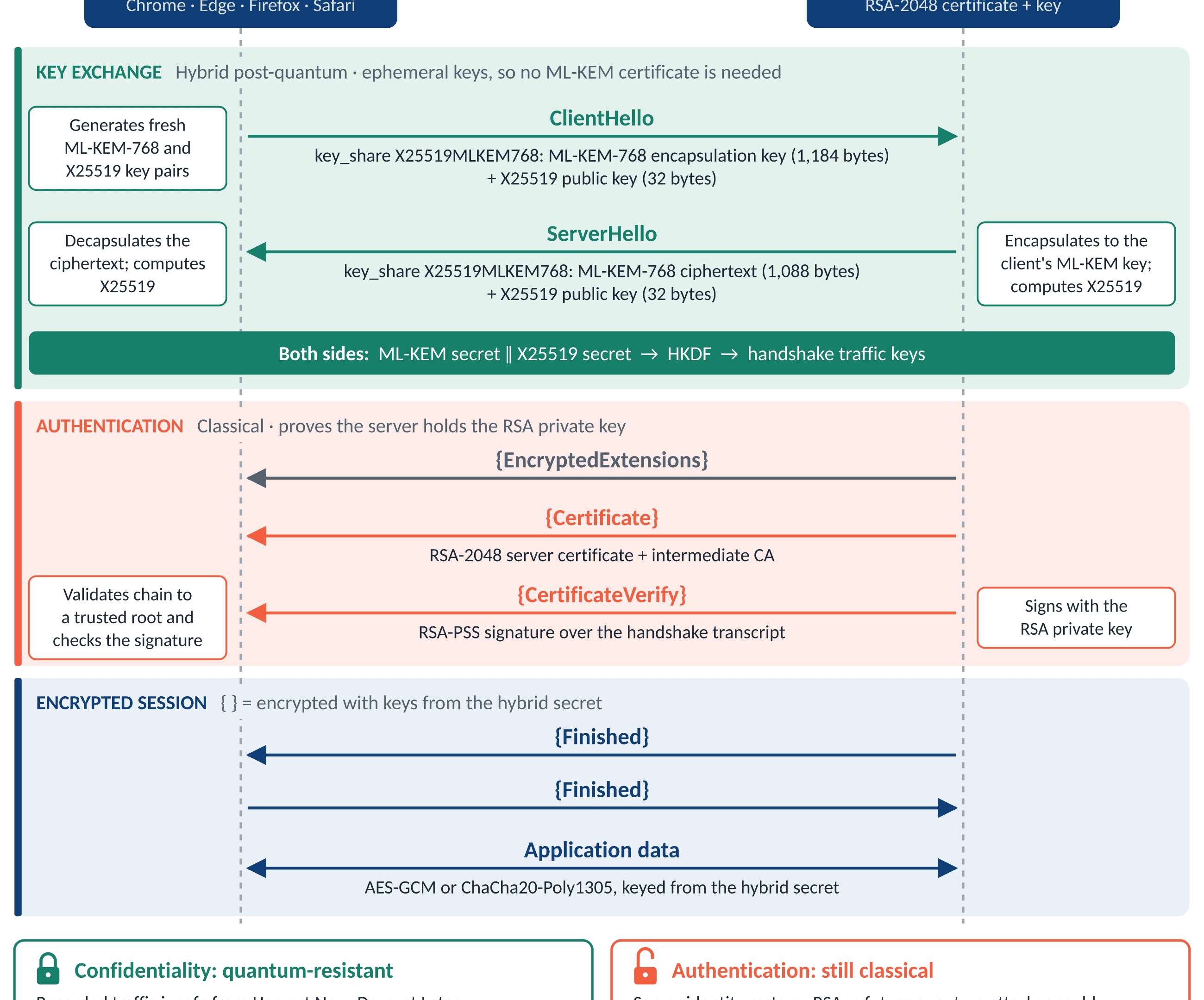
Figure 2. TLS 1.3 handshake with hybrid ML-KEM key exchange and an RSA certificate. ML-KEM protects the session keys against future decryption; the RSA certificate and RSA-PSS signature still authenticate the server.
Two post-quantum standards are particularly relevant to modern browsers.
1. ML-KEM: Protecting Key Exchange
ML-KEM (Module-Lattice-Based Key-Encapsulation Mechanism) is defined in NIST FIPS 203.
ML-KEM allows two communicating systems to establish shared secret key material over an untrusted network.
That shared secret can subsequently be used to derive the symmetric encryption keys protecting the connection.
ML-KEM is designed to resist attacks from both conventional and quantum computers.
For browser TLS connections, ML-KEM-768 is commonly combined with the classical X25519 algorithm in a hybrid key exchange named X25519MLKEM768.
This combination is already deployed across major web browsers and supporting TLS servers. It can be used with classical ECC/RSA certificates or post-quantum ML-DSA certificates.
2. ML-DSA: Protecting Digital Signatures and Identity
ML-DSA (Module-Lattice-Based Digital Signature Algorithm) is defined in NIST FIPS 204.
While ML-KEM protects key establishment, ML-DSA provides post-quantum digital signatures.
These signatures can be used to verify the authenticity and integrity of certificates, documents, software and other digitally signed information.
In PKI environments, ML-DSA can be used for:
- Generating post-quantum signing keys.
- Creating and signing X.509 certificates.
- Issuing certificates from ML-DSA Certificate Authorities.
- Authenticating TLS servers using ML-DSA private keys.
- Validating certificate chains containing ML-DSA signatures.
ML-DSA has three standardised parameter sets: ML-DSA-44, ML-DSA-65 and ML-DSA-87, providing different security and performance characteristics.
The use of ML-DSA in X.509 certificates and Certificate Revocation Lists was standardised in RFC 9881 in October 2025.
Together, ML-KEM and ML-DSA provide the foundations for post-quantum key establishment and authentication.
Current Browser Support
Status as of late 2026:
Browser | Hybrid PQC key exchange | ML-DSA certificates in private PKI |
|---|---|---|
Google Chrome | Supported since Chrome 131 | Supported since Chrome 150 |
Microsoft Edge | Supported since Edge 131 | Not yet supported |
Mozilla Firefox | Supported since Firefox 132 | Not yet supported |
Apple Safari | Supported since Safari 26 | Not yet supported |
Note that Chrome’s ML-DSA certificate support only extends to private PKIs. ML-DSA with publicly trusted CAs (Let’s Encrypt, Digicert etc.) relies on Merkle-Tree certificates which are not yet implemented by any web browser. Merkle-Tree certificate support is planned for 2027.
Classical Cryptography vs Post-Quantum Cryptography
The transition to PQC is not simply an exercise in choosing stronger key lengths.
Classical and post-quantum algorithms rely on different mathematical assumptions.
Classical Public-Key Cryptography
RSA relies on the difficulty of factoring large integers.
Elliptic Curve Cryptography, including ECDH, ECDSA, X25519 and Ed25519, relies on the difficulty of related discrete logarithm problems.
These mathematical problems are difficult for conventional computers when appropriate key sizes are used. However, Shor's quantum algorithm provides an efficient theoretical approach to solving the underlying mathematical problems on a sufficiently powerful, fault-tolerant quantum computer.
Increasing RSA or ECC key sizes is therefore not considered a sustainable long-term solution to this quantum threat.
Post-Quantum Cryptography
ML-KEM and ML-DSA are based on mathematical problems involving structured lattices. Their security is related to problems such as Module Learning with Errors and related lattice constructions.
No efficient quantum algorithm is currently known that breaks these standardised schemes at their intended security levels. However, post-quantum algorithms remain subject to ongoing cryptanalysis, implementation review and operational testing. This is one reason hybrid cryptography is important during the transition.
Algorithm Comparison
Algorithm | Purpose | Quantum-resistant? | Considerations |
|---|---|---|---|
RSA-2048 | Signatures and encryption | No | Widely compatible |
ECC P-256 | Digital signatures and key agreement | No | Compact signatures, widely compatible |
X25519 | Key agreement | No | Efficient 32-byte public keys |
Ed25519 | Digital signatures | No | Efficient 64-byte signatures |
ML-KEM-768 | Key encapsulation | Yes | Large public keys, large ciphertexts |
ML-DSA-44/ML-DSA-65/ML-DSA-87 | Digital signatures | Yes | Large signatures, large public keys |
AES-256 | Symmetric encryption | Yes | Remains secure against quantum computers |
SHA-256 | Cryptographic hash | Yes | Hash functions remain secure |
Unlike RSA and ECC, AES and modern cryptographic hash functions are not directly broken by Shor's algorithm. Quantum search algorithms can affect their security margins, but appropriately selected symmetric cryptography remains an important part of post-quantum systems.
Performance and Size Differences
One of the most important deployment considerations is that post-quantum certificates and signatures are considerably larger than many classical alternatives.
Representative public-key and signature sizes are shown below.
Signature algorithm | Public key | Signature |
|---|---|---|
Ed25519 | 32 bytes | 64 bytes |
ML-DSA-44 | 1,312 bytes | 2,420 bytes |
ML-DSA-65 | 1,952 bytes | 3,309 bytes |
ML-DSA-87 | 2,592 bytes | 4,627 bytes |
Note that these are raw sizes, excluding X.509 encoding or other certificate or TLS overhead.
The increased message sizes have implications for network devices, TLS handshake performance and large certificate chains.
These differences help explain why browser vendors are pursuing different approaches for private PKI and the public internet.
Public PKI: Why Browsers are Developing Merkle-Tree Certificates
Although Chrome supports ML-DSA X.509 certificates for private PKI, Google has chosen a different long-term strategy for publicly trusted post-quantum HTTPS authentication. In February 2026, Google announced the development of a dedicated Chrome Quantum-resistant Root Program.
Rather than directly introducing large post-quantum X.509 certificate chains into the existing Chrome Root Store, Google is developing support for Merkle Tree Certificates (MTCs). MTCs are intended to reduce the bandwidth and performance overhead associated with post-quantum signatures.
Traditional X.509 certificate hierarchies normally require a browser to verify a sequence of certificate signatures. When those signatures use post-quantum algorithms, the transmitted certificate chain may become significantly larger.
Merkle Tree Certificates use a different model: A Certificate Authority cryptographically commits to a collection of issued certificates using a Merkle tree and signs a representation of that tree. The browser can then validate a compact cryptographic proof showing that a particular certificate belongs to the authenticated tree. This avoids requiring a separate large CA signature to be transmitted for every individual certificate. MTCs also incorporate certificate transparency more directly into the issuance and verification process.
What Organisations Need to Consider
PQC adoption introduces several important operational considerations.
1. Browser and application compatibility
Support for hybrid TLS key exchange does not imply support for ML-DSA certificates.
Organisations must independently verify certificate-chain validation, TLS signature negotiation and endpoint compatibility.
2. TLS termination and inspection
Load balancers, reverse proxies, content delivery networks and TLS inspection devices may terminate encrypted connections.
Each TLS connection must be evaluated separately. Protecting the browser-to-proxy connection does not automatically protect the proxy-to-origin connection.
3. Certificate and handshake sizes
Larger public keys and signatures can increase handshake traffic, require additional network packets and expose limitations in older TLS appliances or middleware.
4. Cryptographic key management
PKI systems, cryptographic providers and Hardware Security Modules must support the intended algorithms, key formats and signing operations.
Algorithm support and certification of a cryptographic implementation are separate considerations; support for ML-DSA does not by itself establish FIPS 140-3 validation.
5. Long-term interoperability
Organisations may need to operate classical and post-quantum certificate hierarchies in parallel while older applications are updated.
6. Security assurance and downgrade resistance
A successful post-quantum handshake does not necessarily mean every part of the connection is quantum-resistant.
Both key establishment and authentication must be assessed.
Where classical certificate authorities or signing keys remain accepted, organisations also need to consider downgrade and impersonation risks from future quantum-capable adversaries.
Verifying Post-Quantum TLS in a Browser
Organisations can begin validating browser post-quantum support without deploying an entirely new PKI.
Check Hybrid Key Exchange
Use a current Chrome, Edge, Firefox or supported Safari environment to connect to a post-quantum-enabled TLS server.
In Chrome or Edge:
- Open the website.
- Open Developer Tools using F12.
- Select the Security panel.
- Inspect the connection details.
- Confirm that the negotiated key-exchange group is X25519MLKEM768.
A successful negotiation demonstrates that the tested TLS connection uses hybrid post-quantum key establishment.
The Cloudflare test service at pq.cloudflareresearch.com can also be used to check browser connectivity to a post-quantum-enabled server.
Check ML-DSA Certificate Authentication
For private PKI testing:
- Configure a private ML-DSA Certificate Authority and issue an appropriate TLS server certificate.
- Deploy the certificate to a TLS 1.3 server with ML-DSA authentication support.
- Establish trust in the private CA on a managed Chrome 150+ device.
- Connect to the test application and inspect the certificate information.
- Confirm that the certificate path and TLS authentication use the expected ML-DSA algorithms.
- Independently verify that hybrid key exchange is negotiated.
Modern cryptographic libraries, including OpenSSL 3.5 and later, provide ML-KEM and ML-DSA capabilities that can be used to support interoperability testing.
Testing should include the actual web server, browser, certificate hierarchy and any intermediate network appliances.
About Cogito Group
Cogito Group is an award-winning, Australian owned and operated ICT company, specialising in authentication, cloud security, identity management and data protection. Cogito Group protect the authentication methods used to access information through the use of Identity and other security technologies. Cogito Group protect data not only from unauthorised access and disclosure, but also from being altered by an unauthorised third party or a trusted insider with malicious intent. This assists in the detection and prevention of fraud or other malicious activities by third parties or trusted insiders.