
Introduction
This paper compares the cost of Microsoft Active Directory Certificate Services (AD CS) with the cost of Cogito Group’s Jellyfish CA when both are hosted on Microsoft Azure. AD CS is often treated as free, because the role comes with Windows Server. This paper shows that, as soon as you run more than one Certificate Authority (CA), the real-world cost of that free service is higher than the cost of Jellyfish CA, even though Jellyfish CA is Common Criteria certified and NIAP listed.
Summary
AD CS allows one CA per Windows Server, so every CA you run on Azure is another Windows virtual machine (VM) to pay for, patch and back up. Jellyfish CA runs all your CAs on one VM.
With two CAs, Jellyfish CA costs USD 3,504 a year including its Azure hosting, against USD 3,676 for AD CS. Every further CA widens the gap: at ten CAs Jellyfish CA costs USD 10,269 a year against USD 14,988, a saving of 31%.
Cost is only part of the case. Jellyfish CA searches every CA from one console, is Common Criteria certified and NIAP listed, supports post-quantum algorithms today, runs active-active across sites, and supports the enrolment protocols that non-Windows devices need.
What Two CAs Cost on Azure
We compared a common starting point: a small CA issuing about 1,000 certificates and a mid-sized CA issuing about 5,000. AD CS needs a Windows Server VM for each. Jellyfish CA runs both on one VM the same size as the smaller AD CS VM.
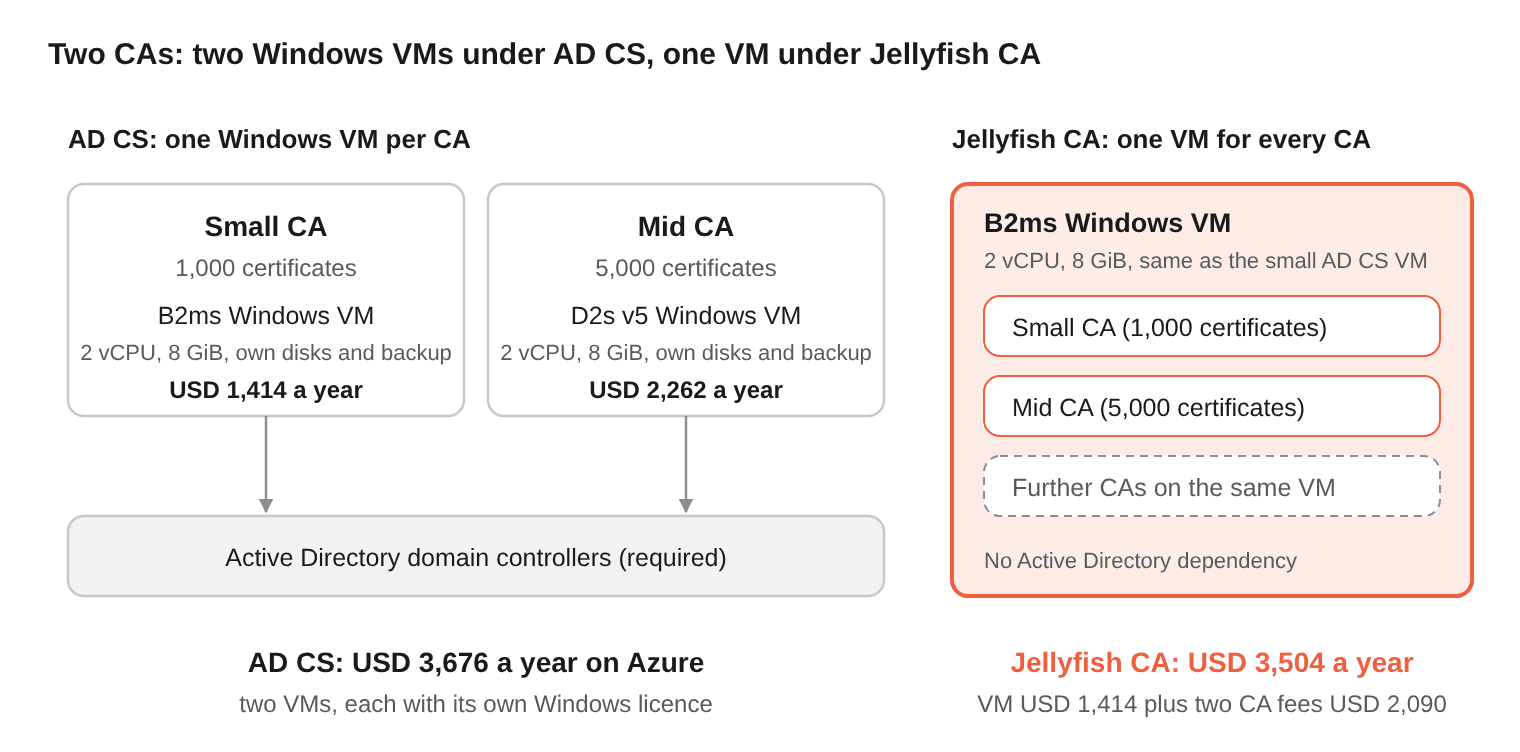
The second AD CS VM costs USD 2,262 a year. Jellyfish CA replaces it with two CA fees totalling USD 2,090, so you are USD 172 a year better off from the second CA.
Annual cost on Azure (USD) | Microsoft AD CS | Cogito Jellyfish CA |
|---|---|---|
Small CA (1,000 certificates) | B2ms Windows VM: 1,414 | One B2ms Windows VM for both CAs: 1,414 |
Mid CA (5,000 certificates) | D2s v5 Windows VM: 2,262 | Same VM: 0 |
Jellyfish CA fees | None | 1,100 + 990 = 2,090 |
Total a year | 3,676 | 3,504 |
Each VM figure includes compute with the Windows Server licence, a 128 GiB OS disk and a 64 GiB data disk, daily geo-redundant backup, Microsoft Defender for Servers Plan 1 and 2 GB a month of Log Analytics. Azure retail list prices, East US, USD excluding tax, pay-as-you-go, 8 November 2026.
The Saving Grows With Every CA
Each extra AD CS CA is another Windows VM, about USD 1,414 a year even on the smallest suitable size. Each extra Jellyfish CA adds only its fee on the VM you already run, and the fee falls as you add CAs. With a single CA, AD CS on one VM costs less; from the second CA, Jellyfish CA costs less, and the saving keeps growing.
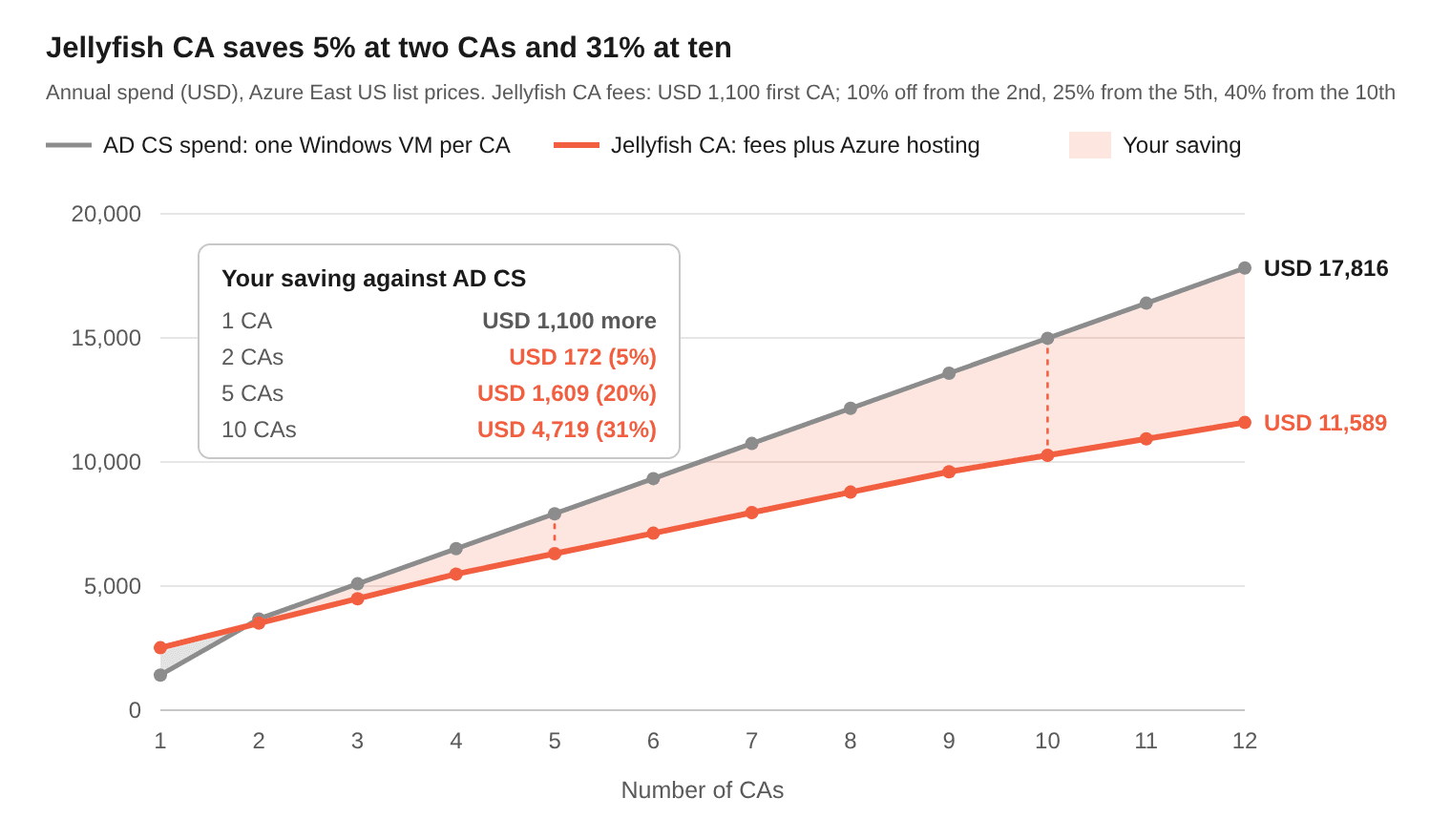
Number of CAs | AD CS (USD a year) | Jellyfish CA, including hosting (USD a year) | Your saving (USD a year) |
|---|---|---|---|
1 CA | 1,414 | 2,514 | 1,100 more |
2 CAs | 3,676 | 3,504 | 172 (5%) |
3 CAs | 5,090 | 4,494 | 596 (12%) |
4 CAs | 6,504 | 5,484 | 1,020 (16%) |
5 CAs | 7,918 | 6,309 | 1,609 (20%) |
10 CAs | 14,988 | 10,269 | 4,719 (31%) |
12 CAs | 17,816 | 11,589 | 6,227 (35%) |
Further AD CS CAs are costed on the smallest suitable VM (B2ms). Larger VMs would widen the gap.
Jellyfish CA Pricing
Jellyfish CA is priced per CA, with no charge for the number of certificates a CA issues. The first CA carries the full fee, and volume discounts apply from the 2nd, 5th and 10th CA.
CAs | Discount | Fee per CA (USD a year) |
|---|---|---|
1st CA | None | 1,100 |
2nd to 4th CA | 10% | 990 |
5th to 9th CA | 25% | 825 |
10th CA and above | 40% | 660 |
Each band’s fee applies to the CAs in that band: five CAs cost 1,100 + 3 × 990 + 825 = USD 4,895 a year, and ten CAs USD 8,855. Fees exclude tax and cover each CA on the Jellyfish CA VM, with updates and support.
Costs Outside the Comparison
Several costs sit outside the figures above, and most of them add to the cost of AD CS:
- Domain controllers. An AD CS Enterprise CA must be joined to Active Directory. With no domain controllers in Azure, two add about USD 2,500 a year. Jellyfish CA does not depend on Active Directory.
- HSM protection. AD CS cannot keep its keys in Azure Key Vault, so HSM-protected AD CS on Azure needs Azure Cloud HSM, at about USD 42,000 a year for a three-node cluster. Jellyfish CA’s HSM connector supports Azure Key Vault HSM as well as on-premises, AWS and Jellyfish Cloud HSMs.
- Administration. Cogito estimates each AD CS CA server takes about two hours of administration a month, against one hour a month for the single Jellyfish CA server: about USD 3,600 a year more for two CAs at USD 100 an hour.
- Windows Server licences. These are included in the Azure prices above. With Azure Hybrid Benefit you pay for the same licences through Software Assurance instead, and must keep renewing it to keep the benefit. Jellyfish CA can also run on Linux, where no Windows Server licence is needed.
- Post-quantum migration. ML-DSA needs new AD CS CAs, each on its own Windows Server. Jellyfish CA runs a post-quantum hierarchy alongside your existing one on the same platform.
Why Jellyfish CA
Search Across Every CA
The AD CS console filters one CA’s database at a time, with no reporting, no dashboard and no view across CAs. Finding a certificate in a large database, and working out where it is installed, takes PowerShell or certutil skills and time. Jellyfish CA searches the certificates, requests, CRLs and templates of every CA it hosts from one console, by name or by status, such as every revoked certificate.
Independently Certified
Cogito Jellyfish Certificate Authority version 7.0 was certified on 29 April 2026 under the Australian Information Security Evaluation Program (AISEP), operated by the Australian Signals Directorate, after evaluation by Viden Labs against the NIAP Protection Profile for Certification Authorities v2.1 (PP-CA). The certification is valid until 29 April 2031, is issued under the Common Criteria Recognition Arrangement, and Jellyfish CA is listed by NIAP against the PP-CA.
No current version of AD CS holds a Common Criteria certificate as a CA. Microsoft’s current certifications evaluate the Windows operating system, not the CA role’s issuance, revocation, role separation and audit functions. For government, defence and critical infrastructure buyers that prefer or require evaluated products, Jellyfish CA can point to an evaluation of the CA itself.
Post-Quantum Ready Today
NIST IR 8547 deprecates quantum-vulnerable algorithms such as RSA and ECDSA after 2030 and disallows them after 2035, and the Australian Signals Directorate’s Information Security Manual requires traditional asymmetric cryptography to be retired by the end of 2030. The CA has to move first, because every certificate it issues depends on its signature algorithm.
AD CS added ML-DSA signing in May 2026, but only for new CAs on Windows Server 2025, with no ML-KEM, no SLH-DSA and no ML-DSA enrolment through NDES. Jellyfish CA supports ML-DSA, ML-KEM and SLH-DSA today, alongside RSA and ECC, and runs a post-quantum hierarchy beside your classical one without new servers.
Many CAs on One Platform
AD CS is limited to one CA per Windows Server and is not supported in Windows containers or on Kubernetes, so every new CA, whether for users, devices, partners or a post-quantum hierarchy, needs another server. Jellyfish CA runs many CAs on one platform: Cogito’s own testing has run 100,000 CAs concurrently on a single VM using 1.4 GB of memory, and the published minimum for a Jellyfish CA node is 250 MB of base memory.
Active-Active High Availability
AD CS supports only an active-passive failover cluster on shared storage. Running separate issuing CAs on different sites keeps issuance going, but not revocation: only the CA that issued a certificate can revoke it, so a compromised certificate stays trusted while that CA is down. Jellyfish CA runs active-active across sites and regions, so the loss of a node or a site stops neither issuance nor revocation.
Enterprise Database and Reliable Recovery
AD CS stores its data in ESE, an embedded database with no replication, no clustering and no point-in-time recovery, so a CA can only be restored to its last backup and certificates issued since then are lost from its records. Jellyfish CA uses PostgreSQL, which you can replicate, cluster, back up and restore to any point in time with the tools you already use, or SQLite for small deployments. Its separate Registration Authority keeps its own record of every request, so no certificate is left unmanaged after a recovery.
Automation for Every Device
AD CS supports Microsoft’s own enrolment protocols and SCEP through NDES, with no native ACME, EST or CMP and no modern REST API, which limits it for Linux servers, Kubernetes workloads, network equipment and IoT devices. Jellyfish CA supports ACME, EST, CMP, SCEP, CMC and Microsoft autoenrolment natively, so Windows autoenrolment keeps working when you move from AD CS.
A True Registration Authority and Fewer Attack Paths
AD CS has no Registration Authority beyond NDES, a SCEP proxy. Its certificate templates and CA settings are a well-known route to domain compromise: researchers have catalogued sixteen escalation techniques, ESC1 to ESC16, and free tools exploit them automatically. Jellyfish CA has a separate RA with its own database, which can run on a network-segregated server so the CA itself need not be reachable from user or device networks, and RA-enforced policy removes the template and CA settings these techniques abuse.
Live Migration From AD CS
Moving AD CS to a new server is a manual backup-and-restore project, and there is no in-place path to post-quantum algorithms. Jellyfish Live CA Migration runs your existing CA, whether AD CS, Verizon UniCERT, EJBCA, Entrust Authority Security Manager or OpenSSL, in parallel with Jellyfish CA, importing certificate records and revocation status on a frequent schedule, so applications move across gradually without a disruptive cut-over.
Scale and Cloud Freedom
In Cogito’s experience, AD CS administration slows noticeably once a CA holds more than 1 million certificates, and capacity cannot be added by running the same CA on more servers. Jellyfish CA is rated at up to 3,200 certificates per minute and scales out across nodes on Docker Swarm or Kubernetes. It runs on Linux or Windows, in Docker or on Kubernetes, and its HSM connector works across on-premises, AWS, Azure and Jellyfish Cloud HSMs.
Disconnected, Intermittent or Connected
Jellyfish CA is specifically designed to support three kinds of environment: permanently disconnected networks, networks with intermittent connections, and permanently connected environments. One CA product can therefore serve isolated, remote and corporate networks alike.
In connected environments, Jellyfish CA is part of the wider Jellyfish Certificate Lifecycle Management (CLM) platform and fully integrated with it, so the certificates it issues are managed in the same platform as those from your other CAs.
AD CS and Jellyfish CA Compared
The table below summarises the differences in this paper.
Capability | Microsoft AD CS | Cogito Jellyfish CA |
|---|---|---|
Azure cost, two CAs | USD 3,676 a year on 2 Windows VMs | USD 3,504 a year on 1 VM, including CA fees |
Azure cost, ten CAs | USD 14,988 a year on 10 Windows VMs | USD 10,269 a year on 1 VM, including CA fees |
Search | One CA’s database at a time, through the console or certutil | Every CA’s certificates, requests, CRLs and templates from one console |
Independent security certification | No current Common Criteria certification of the CA role | Common Criteria certified against NIAP PP-CA v2.1 and NIAP listed |
Post-quantum | ML-DSA only, on new Windows Server 2025 CAs; ML-KEM planned; no SLH-DSA | ML-DSA, ML-KEM and SLH-DSA |
CAs per server | One | Many CAs per instance |
High availability | Active-passive failover cluster on shared storage | Active-active, multi-region |
Database | Embedded ESE, no replication; restore to last backup only | PostgreSQL with point-in-time recovery, or SQLite |
Enrolment protocols | MS-WCCE, CEP/CES, Web Enrollment, SCEP via NDES | ACME, EST, CMP, SCEP, CMC and Microsoft autoenrolment |
Registration Authority | None; NDES acts only as a SCEP proxy | Separate RA with its own database, can be network-segregated |
Migration | Manual backup and restore; no import from other CAs | Live, parallel migration from AD CS, UniCERT, EJBCA, Entrust and OpenSSL CAs |
Platforms | Windows Server only | Linux or Windows, Docker, Kubernetes |
Network environments | Enterprise CA needs Active Directory available | Designed for permanently disconnected, intermittently connected and connected networks; part of the Jellyfish CLM platform when connected |
Azure Key Vault HSM | Not supported | Supported through the Jellyfish HSM connector |
How We Calculated
- Prices. Azure retail list prices for East US (Virginia), in USD excluding tax, pay-as-you-go, on 8 November 2026, at 730 hours a month. Pay-as-you-go prices include the Windows Server licence.
- Each VM. Compute, a 128 GiB OS disk and a 64 GiB data disk, daily backup to geo-redundant storage, Microsoft Defender for Servers Plan 1 and 2 GB a month of Log Analytics.
- Jellyfish CA. One VM the same size and Windows image as the smaller AD CS VM, plus the Jellyfish CA fees. On Linux the VM costs about USD 70 a year less.
- Further CAs. Each further AD CS CA is costed on the smallest suitable Windows VM (B2ms), the lowest-cost case for AD CS.
- Not included. An offline root CA, Azure Bastion and networking, which both options need, and the domain controllers, HSMs and administration described above.
- Your estate. If you already use Azure Hybrid Benefit or 3-year VM reservations, AD CS costs less than shown and the saving starts from the third or fourth CA rather than the second. Cogito can model your own estate and Azure agreement.
Conclusion
AD CS suits small, Microsoft-only environments that need one CA and little else. As soon as you need a second CA, Jellyfish CA costs less on Azure, and every further CA adds to the saving. It also brings what AD CS lacks: search across every CA, independent Common Criteria certification, post-quantum algorithms today, active-active availability, an enterprise database with point-in-time recovery, and automation for every kind of device.
About Cogito Group
Cogito Group is an award-winning, Australian owned and operated ICT company, specialising in authentication, cloud security, identity management and data protection. Cogito Group protect the authentication methods used to access information through the use of Identity and other security technologies. Cogito Group protect data not only from unauthorised access and disclosure, but also from being altered by an unauthorised third party or a trusted insider with malicious intent. This assists in the detection and prevention of fraud or other malicious activities by third parties or trusted insiders.
Cogito specifically developed the Jellyfish Certificate Lifecycle Management capability as part of the wider Jellyfish platform to address some of the limitations of the Microsoft AD CS platform. Later, Cogito also developed Jellyfish CA (also known as Leviathan CA) to overcome the remaining issues around scale, reliability, post-quantum readiness and product support of the AD CS platform. Jellyfish CA version 7.0 is Common Criteria certified and NIAP listed.